Enterprise resource planning systems continue to evolve as businesses demand faster reporting, flexible integrations, stronger automation, and better access to operational data.
In 2026, ERP modernization is increasingly focused on cloud deployment, artificial intelligence, modular architecture, mobile access, industry-specific functionality, and stronger data governance.
These developments do not mean every business needs to replace its current ERP system immediately. Instead, organizations should evaluate which capabilities address real operational problems, improve decision-making, and support long-term growth.
This article examines the ERP trends shaping enterprise software in 2026 and explains what they mean for businesses planning an ERP implementation or modernization project.
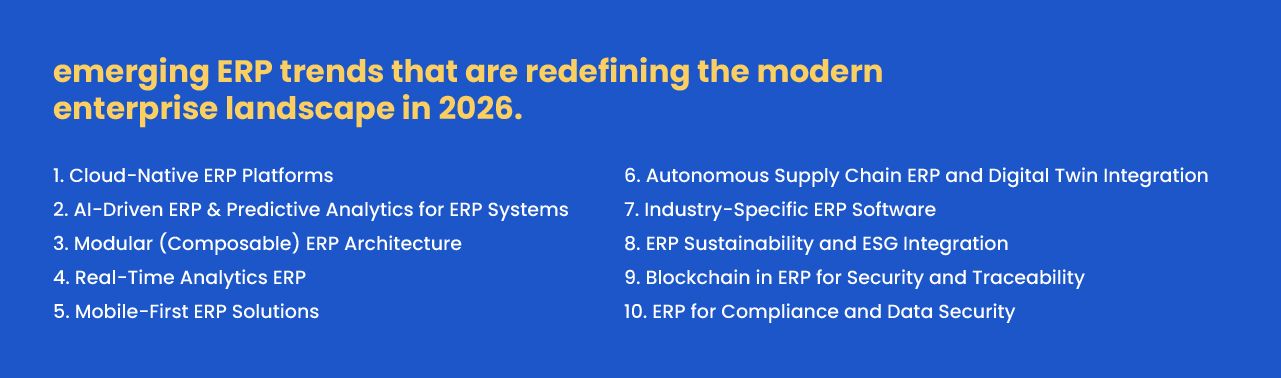
Top ERP Trends Shaping Enterprise Software in 2026
1. Cloud-Native ERP Platforms
Cloud-native ERP systems are designed specifically for cloud environments rather than being adapted from older on-premise software.
These platforms can support more flexible scaling, remote access, automated updates, and integration with other cloud applications.
Businesses are also exploring hybrid and multi-cloud ERP environments to balance performance, regional hosting requirements, system availability, and vendor dependency.
However, moving ERP software to the cloud does not automatically reduce costs or simplify operations. Businesses should still evaluate subscription pricing, data migration, integration requirements, security responsibilities, and long-term support.
2. AI-Assisted ERP Workflows
Artificial intelligence is increasingly being added to ERP systems to support forecasting, document processing, anomaly detection, reporting, and workflow recommendations.
An AI-enabled ERP platform may help identify unusual transactions, predict inventory requirements, summarize operational data, or assist users in finding information.
These capabilities should support human decision-making rather than operate without oversight. Forecasts and recommendations depend on data quality, system configuration, and the context in which the results are used.
3. Composable and Modular ERP Architecture
Businesses are moving away from large ERP implementations that require every department to adopt the same rigid system at once.
A modular ERP system allows companies to implement specific capabilities such as finance, inventory, customer management, manufacturing, or warehouse operations according to business priorities.
Composable ERP architecture extends this approach by connecting specialized applications through APIs and shared data services.
This can reduce the risk of large-scale implementation projects, but it also requires careful integration planning, data ownership rules, and ongoing system governance.
4. Real-Time ERP Analytics
Businesses increasingly expect ERP systems to provide current operational information rather than relying entirely on scheduled reports.
Real-time ERP analytics can help managers monitor production, inventory, sales, purchasing, finance, and logistics as activity occurs.
This may allow teams to identify delays, shortages, unusual expenses, or performance issues earlier.
Real-time reporting is only valuable when the underlying data is accurate. Businesses should establish clear data-entry, validation, and integration processes before relying on dashboards for operational decisions.
5. Mobile ERP Access
Mobile ERP solutions allow authorized users to access workflows, dashboards, approvals, and reports from phones or tablets.
This can be useful for warehouse teams, field service employees, production managers, sales representatives, and executives who do not work exclusively from a desk.
Mobile ERP design should focus on the tasks users need to complete while away from a desktop rather than attempting to reproduce every feature on a smaller screen.
Businesses should also apply secure authentication, role-based permissions, session controls, and appropriate device policies.
6. Connected Supply Chain Planning
ERP systems are becoming more closely connected with warehouse management software, transportation systems, supplier platforms, ecommerce applications, and Internet of Things devices.
These integrations can improve visibility across purchasing, inventory, production, shipping, and order fulfillment.
Some businesses are also exploring digital twins to model production lines, warehouse activity, equipment, or supply chain networks.
Digital twins can support simulation and planning, but they require reliable operational data and clearly defined use cases. They are not a practical requirement for every ERP implementation.
7. Industry-Specific ERP Software
Generic ERP platforms often require extensive configuration before they can support specialized business processes.
Industry-specific ERP systems include workflows and data structures designed for sectors such as manufacturing, distribution, logistics, healthcare, retail, and professional services.
For example, manufacturing ERP software may include bill of materials management, production planning, quality control, batch tracking, and equipment maintenance.
Preconfigured industry capabilities can reduce customization, but businesses should still confirm that the system matches their actual processes rather than relying on an industry label.
8. Sustainability and Operational Reporting
Businesses face increasing pressure to monitor energy use, material consumption, waste, supplier practices, and emissions.
ERP systems can support this work by collecting environmental and operational data alongside financial and supply chain information.
For example, a logistics business may analyze fuel use, shipping routes, carrier performance, or warehouse energy consumption.
Sustainability reporting depends on consistent data collection and clearly defined measurement methods. Adding a dashboard does not make incomplete environmental data reliable.
9. Greater Traceability Across Transactions
Businesses are seeking stronger traceability across supply chains, financial transactions, regulated products, and supplier activity.
ERP systems can support this through audit logs, serial and batch tracking, approval histories, access controls, and connected transaction records.
Blockchain may be useful in specific multi-party processes where several independent organizations need to verify shared records. However, conventional databases and ERP audit controls remain more practical for many business requirements.
Organizations should select the simplest technology that provides the required security, traceability, and control.
10. Stronger ERP Security and Compliance Controls
ERP systems contain financial records, employee information, customer data, supplier details, pricing, inventory, and operational data.
As a result, ERP data security and compliance remain central to system planning.
Modern ERP platforms may support:
- Role-based access controls
- Multi-factor authentication
- Audit logs
- Encryption
- Backup and recovery procedures
- Data retention controls
- Security monitoring
- Approval workflows
Businesses should also define responsibility for updates, access reviews, incident response, data hosting, and third-party integrations.
What These ERP Trends Mean for Businesses
Not every ERP trend will be relevant to every organization. A business should not adopt artificial intelligence, composable architecture, digital twins, or blockchain simply because those technologies appear in industry discussions.
ERP modernization should begin with practical questions:
- Which processes create the most delays or errors?
- Which departments lack reliable information?
- Which integrations are difficult to maintain?
- Which reports are unavailable or outdated?
- Which security or compliance controls need improvement?
- Can the current system support expected business growth?
The answers can help determine whether the organization needs a complete ERP replacement, a phased modernization project, new integrations, or improvements to the existing system.
How to Prepare for ERP Modernization in 2026
Review Existing Processes
Document how finance, procurement, inventory, sales, manufacturing, warehousing, and customer service currently operate.
Identify System Gaps
Determine where users rely on spreadsheets, manual workarounds, duplicated data, or disconnected applications.
Prioritize Business Outcomes
Define measurable objectives such as reducing order processing time, improving inventory accuracy, shortening financial close, or increasing reporting visibility.
Assess Data Quality
Review customer, product, supplier, inventory, and financial records before moving them into a modernized ERP environment.
Plan Integrations
Identify ecommerce, warehouse, logistics, payment, CRM, and other systems that must exchange data with the ERP platform.
Evaluate Security and Governance
Define user permissions, approval rules, audit requirements, data retention, backup procedures, and integration ownership.
Use a Phased Implementation Approach
A phased rollout can reduce implementation risk and allow teams to validate important workflows before expanding the system.
Build an ERP Strategy for 2026 and Beyond
ERP systems are becoming more connected, modular, accessible, and data-driven. Cloud platforms, artificial intelligence, mobile workflows, industry-specific functionality, and stronger security controls are influencing how businesses plan ERP projects in 2026.
The most effective ERP strategy is not the one that adopts the greatest number of emerging technologies. It is the one that solves clear operational problems and creates a system the organization can maintain over time.
Our team can support requirement analysis, ERP architecture, system integration, data migration, custom development, user training, and post-implementation maintenance.