ERP systems contain much of the data businesses use to manage inventory, finance, procurement, sales, manufacturing, and customer operations. The difficulty is not always collecting that data. It is recognizing a problem early enough to act on it.
Artificial intelligence can help ERP users identify unusual transactions, forecast demand, classify documents, recommend replenishment actions, and automate parts of routine workflows. However, adding AI to an ERP system does not automatically improve operations. Its usefulness depends on data quality, integration design, employee oversight, and whether the business has selected a problem worth solving.
This guide examines practical uses of AI in ERP, the benefits and limitations businesses should expect, and a step-by-step approach to implementation.
Traditional ERP systems help businesses manage core operations such as inventory, payroll, finance, sales, and supply chain processes. As companies grow, these systems collect larger volumes of operational data, but teams often struggle to turn that data into timely decisions.
These capabilities help convert operational data into forecasts, alerts, workflow actions, and planning insights across departments.
What Does AI in ERP Mean?
AI in ERP refers to the use of machine learning, language models, predictive analytics, document recognition, and intelligent automation within enterprise resource planning workflows.
A conventional ERP system records transactions and applies predefined business rules. An AI-enabled system can also examine patterns in those records and suggest what may happen next. For example, it might flag an invoice that differs from normal supplier activity, predict when stock will fall below demand, or summarize purchasing activity for a manager.
The ERP remains the system responsible for business data and transactions. AI adds analysis, recommendations, and selected automation around that data. Sensitive actions, particularly those involving payments, purchasing, payroll, compliance, or inventory adjustments, should still follow defined approval rules.
How AI Makes ERP Systems Smarter and More Useful
1. Better Forecasting and Decision Support
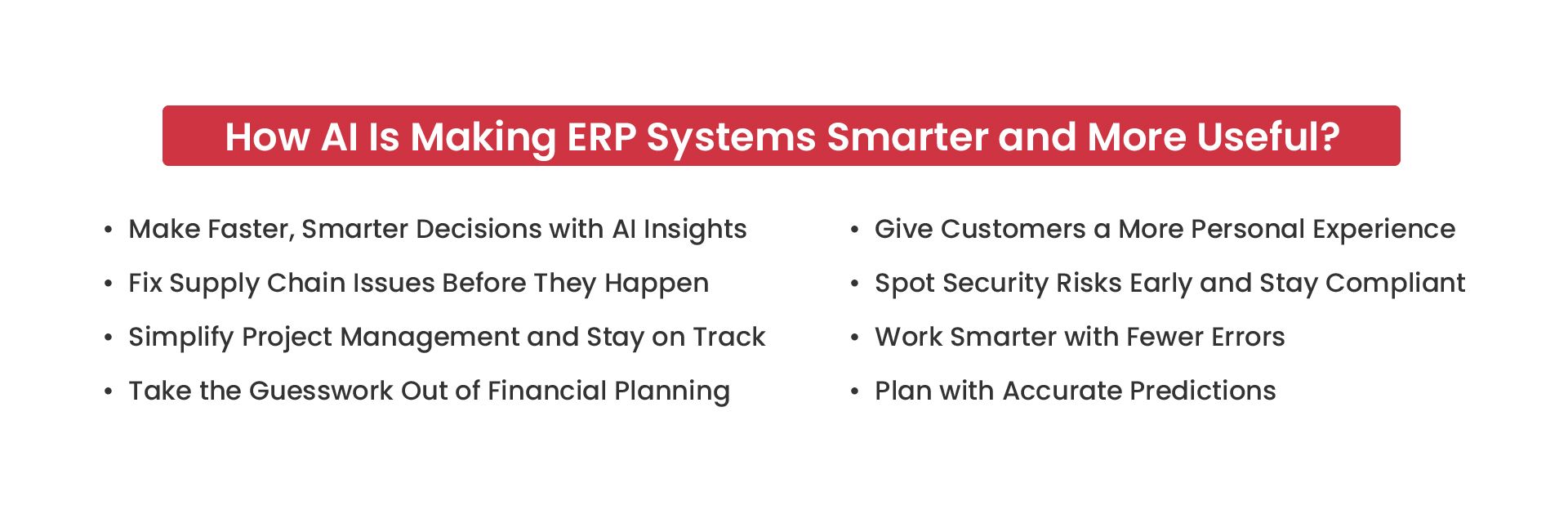
AI can analyze operational data, identify risks, forecast demand, and recommend possible actions. This helps teams plan inventory, budgets, staffing, production, and fulfillment using current information instead of delayed reports or assumptions.
2. Predictive Supply Chain Planning
AI-powered ERP systems can help identify supply chain risks before they create larger operational problems. By analyzing supplier performance, inventory movement, lead times, demand changes, and delivery patterns, AI can help teams spot delays, plan replenishment, and respond earlier to potential disruptions.
3. Smarter Project and Workflow Management
ERP systems often support internal projects, approvals, task tracking, and cross-department workflows. AI can help automate status reporting, identify bottlenecks, suggest priorities, and alert teams when timelines or resources are at risk. This reduces manual follow-up and helps managers keep work moving with better visibility.
4. More Accurate Financial Planning
Finance teams can use AI-powered ERP features to improve cash flow forecasting, expense tracking, invoice review, payment matching, and anomaly detection. AI can analyze financial activity across departments and highlight unusual transactions or spending patterns that may need review before they become costly issues.
5. Stronger Security and Compliance Monitoring
AI-powered ERP systems can help monitor unusual activity, access patterns, transaction behavior, and compliance risks. This is especially useful for businesses handling financial data, customer records, supplier information, and sensitive operational workflows. AI does not replace security controls, but it can add another layer of early detection.
6. Fewer Manual Errors
Manual data entry, repeated approvals, spreadsheet-based tracking, and disconnected reporting can increase the risk of mistakes. AI-enabled ERP workflows can reduce these errors by automating repetitive tasks, validating data, identifying inconsistencies, and helping teams review exceptions instead of checking every record manually.
7. AI Agents for ERP Workflow Automation
AI agents can support ERP workflows by helping users complete multi-step tasks across departments. For example, an AI agent connected to ERP data could help prepare purchase order suggestions, summarize financial reports, check inventory availability, route approval requests, or answer internal business questions using real-time system data.
In enterprise environments, AI agents should be used carefully. They need clear permissions, reliable data access, audit trails, and human review for sensitive actions involving finance, procurement, inventory, compliance, or customer data. The best use of AI agents in ERP is to support teams with faster execution and better visibility, not to give uncontrolled automation access to critical systems.
8. AI-Assisted ERP Development and Customization
AI is also changing how ERP systems are customized and maintained. Developers can use AI coding assistants to understand large ERP codebases, draft service logic, review workflows, generate documentation, and speed up repetitive development tasks. This can be useful for businesses working with open-source ERP frameworks such as Apache OFBiz or Moqui.
However, ERP development requires more than generic code generation. AI-assisted coding should follow framework-specific standards around data models, service layers, transaction handling, security, integrations, and long-term maintainability. Experienced developers should review all AI-generated code before it is used in production.
How AI Integrates with ERP Systems
AI integrates with ERP systems by connecting data from core business modules such as finance, inventory, procurement, sales, CRM, HR, manufacturing, and supply chain operations. Once the data is available through secure integrations, AI tools can analyze patterns, automate repetitive tasks, detect risks, and support faster decision-making.
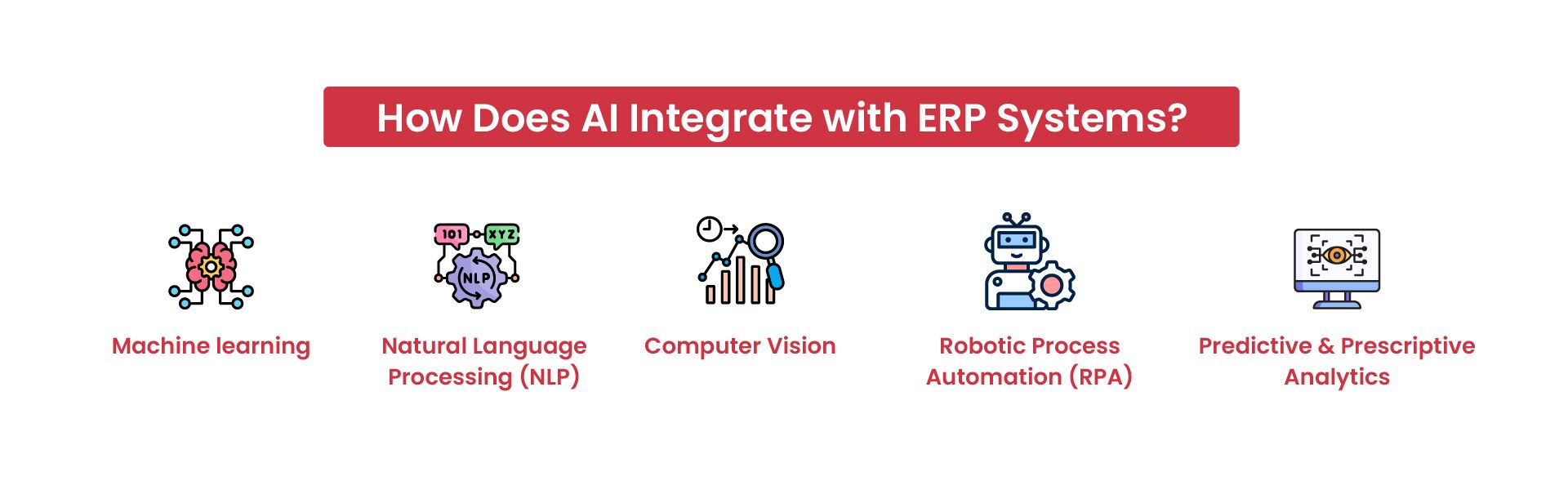
Common AI technologies used in ERP systems include:
- Machine learning: Uses historical data to predict demand, optimize inventory, identify exceptions, and improve planning accuracy.
- Natural language processing: Helps users search ERP data, generate reports, summarize records, and interact with business systems using plain language.
- Computer vision: Supports use cases such as quality inspection in manufacturing, warehouse scanning, document processing, and visual stock analysis.
- Robotic process automation: Automates repetitive tasks such as data entry, invoice processing, approvals, and report generation.
- Predictive and prescriptive analytics: Forecasts likely outcomes and recommends actions for areas such as maintenance, demand planning, procurement, and cash flow management.
- AI agents: Help complete multi-step ERP tasks such as preparing reports, checking inventory availability, summarizing purchase requests, routing approvals, and answering internal business questions.
When these technologies are connected properly, ERP systems become more useful for real-time visibility, workflow automation, forecasting, and decision support. The key is to integrate AI through secure, well-planned workflows rather than adding disconnected tools that create more complexity.
AI-Powered ERP Example: Inventory and Order Automation
Consider a B2B eCommerce company managing thousands of SKUs across multiple warehouses. Without AI support, teams may struggle with inaccurate inventory visibility, delayed replenishment, slow order routing, and manual reporting.
An AI-powered ERP workflow can analyze order history, inventory movement, supplier lead times, warehouse availability, and customer demand patterns. Based on this data, the system can support demand forecasting, replenishment planning, order routing, and fulfillment decisions.
For the business, this can mean fewer manual checks, faster reporting, better inventory planning, and improved order accuracy. The goal is not only automation, but better decision support across inventory, finance, sales, fulfillment, and customer service teams.
For more context, read our guide on AI and ERP transformation.
For a deeper technical example, read our guide on Apache OFBiz AI integration.
Conclusion: Building Smarter ERP Systems with AI
AI is changing how businesses use ERP systems by making enterprise data more actionable. Instead of relying only on manual reports, delayed reviews, and disconnected workflows, companies can use AI-powered ERP features to improve forecasting, automate repetitive tasks, detect risks, and support faster decisions.
At NOI Technologies LLC, we help businesses design and modernize ERP systems through AI services focused on automation, reporting, forecasting, and custom workflow development. Our team works with open-source ERP frameworks such as Moqui Framework and Apache OFBiz to build flexible ERP solutions around real business operations.
For businesses planning ERP modernization, AI can improve the value of existing systems when it is implemented with clean data, secure integrations, and clear human review. The strongest results come from solving specific operational problems first, then expanding AI workflows once they prove useful.
Schedule an AI ERP Consultation
Author Bio:
Visvendra Singh is an ERP and enterprise technology specialist at NOI Technologies with more than 10 years of experience in open-source ERP architecture, business process modernization, and custom software development.